This is a SEO version of AlertDiver_Summer2011_web. Click here to view full version
« Previous Page Table of Contents Next Page »92 | SUMMER 2011
I
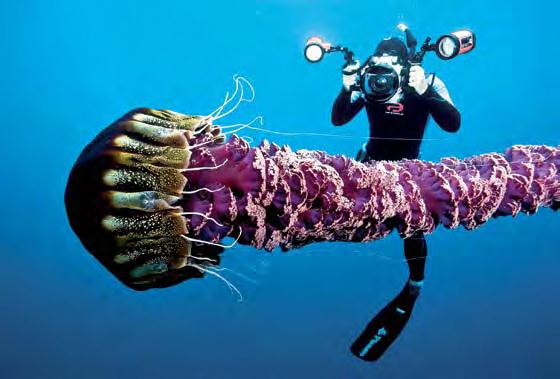
’ve been an underwater shooter since 1980, and over the years I’ve had opportunities to take pictures in many of the world’s best marine environments. After all I’ve experienced on the water planet, my passion and focus have always come back to shooting in the open sea. Blue-water photography typically takes place in water so deep you never see the bottom. Much of the time your environment is a huge, static void where you drift with the currents, waiting for subjects to materialize out of a monochrome background. But when things do happen, it can be absolutely mind-blowing and is where much of the cutting edge of underwater photography is occurring. Open-ocean environments are found far offshore, but they also exist just beyond the “drop” of a coral reef or the outer edge of a kelp forest. Blue-water photography isn’t limited to blue water either; the deep green in places like Alaska and Canada can create the same opportunities that exist in tropical and temperate climates. Many of the subjects you can find in the open sea, or pelagic zone, are different from those found in inshore environments. They can be fleeting and ephemeral, coming and going unpredictably, and may not be seen again in the same area for many years. Blue-water photography has exploded in recent years.
The chance to photograph animals and behaviors never before captured on film is an allure some just can’t resist. In addition to the aesthetic appeal, images might even represent a new discovery. In 1988, off the Los Coronados Islands of Baja California, Howard Hall recorded spectacular footage of a swarm of huge, black jellyfish. These jellyfish, Chrysaora achlyos, had never been filmed before and were virtually unknown to science. National Geographic’s prolific shooter Brian Skerry spent a lot of time early in his career drifting in the open water off the Bahamas. That effort paid off with the first-ever shots of a healthy, living oarfish. Skerry credits those images as extremely important in the progression of his early career.
Today divers and dive operators are much more aware of subjects that may appear during travel over deep water on the way to a dive site. Captains are more willing to stop for dolphins or other animals and let clients in for a photo session. Specialty ecotours offer chances to shoot open-water subjects like the sardine run off South Africa, billfish feeding on bait balls and humpback whale encounters. But blue-water photography is not for everyone. In fact, it’s a lot like gambling. An underwater photographer has to be willing to accept the possibility of some lost time before a big payoff. My
BLUEWATER
T e x t a n d P h o t o s b y R i c h a r d H e r r m a n n
This is a SEO version of AlertDiver_Summer2011_web. Click here to view full version
« Previous Page Table of Contents Next Page »