This is a SEO version of AlertDiver_Summer2011_web. Click here to view full version
« Previous Page Table of Contents Next Page »www.alertdiver.com | 93

blue-water partner, Randy Morse, and I have an unenviable record of six days in a row in his 20-foot skiff without firing a single frame. That’s six 10-hour days of running over miles of open ocean without ever finding a subject to work with!
Subjects That Float
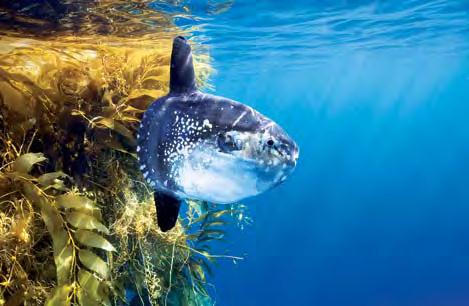
Anything that floats can attract life as it drifts on the open sea. Rafts of marine plants such as kelp paddies off the Pacific coast and sargassum in the tropics can sustain a food chain. Even man-made objects attract life; my favorite example is a drifting computer monitor our film crew found on a shoot in the Azores a couple of years ago. Once microscopic organisms start to grow on a drifting object, the chain of life appears, from algae to baitfish on up the chain to big predators. I have spent many days off the coast of San
Diego, Calif., my home waters, drifting amid kelp paddies. The ocean sunfish, Mola mola, is often found here waiting to be cleaned by halfmoon fish.
For drifting algae rafts, I use a 17-40mm zoom lens on my Canon full-frame digital SLR so I can zoom according to the subject. I like to use fill flash from two strobes to give some “pop” to the animals, referencing the kelp. One benefit of shooting near the surface in a blue-water environment is the abundant ambient light. The art of blending ambient and flash to make an image look natural is learned only through significant trial and error. I try not to override the ambient light with flash, which can make an image appear “hot” or overlit. Animals that generally swim slowly like the mola mola can easily be stopped at a 1/125 of a second sync speed with fill flash.
This is a SEO version of AlertDiver_Summer2011_web. Click here to view full version
« Previous Page Table of Contents Next Page »