This is a SEO version of AlertDiver_Summer2011_web. Click here to view full version
« Previous Page Table of Contents Next Page »
Zooplankton
Gelatinous zooplankton such as jellies, ctenophores and salp chains are examples of plankton you can find in the open sea. Because these animals tend to be medium sized to small, lenses with macro capabilities are best. When isolating one animal, blasting with all the light you can generate while using small apertures will get you that beautifully lit “creature from outer space” look against a jet-black background.
Zooplankton tend to absorb light. I find I simply can’t pound some of these subjects with enough light, especially in macro situations. In wide-angle opportunities with the bigger jellies, you can bring in the ambient light and back off the flash output. Autofocus does not always work when photographing gelatinous creatures; some of these animals are so translucent the autofocus can’t efficiently find them. To shoot these animals, I like to prefocus and then move in and out of focus with my own movements. Using focus lock on the housing or a manual focus gear helps with this technique.
Sharks and Other Big Animals
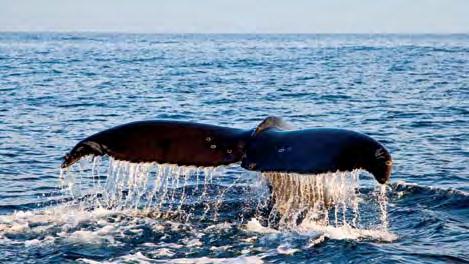
There may be nothing more exciting than facing an open-water shark as it swims up to your lens for the “money shot.” When shooting sharks close to the surface, you may have quite a bit of illumination from the sun. Yet I like flash fill for sharks and other medium-sized animals, especially when the mouth and teeth are in the shadow of their sunlit body. Fill light directed at the underside is important to bring contrast and drama to the photo. For whales and other large marine animals, particularly those to which I’m not likely to get
close enough for effective strobe work, I prefer a streamlined available-light camera system to minimize water resistance. If an animal gives you multiple passes, you can experiment with different “looks.” One I like is shooting straight down to isolate the animal against the blue background. Be careful not to point the lens at too much of an upward angle toward the surface, as you may blow out highlights. This is a common problem when shooting close to the surface in open water. I like to shoot fast-moving open-water animals on shutter-priority automatic exposure so I always know I’ve chosen a shutter speed fast enough to stop the animal. I find I need at least 1/320 to stop speeding dolphins, for example. I will shoot on manual if I know I am going to get lots of opportunities, but I prefer to forget about settings when the animal is travelling through many exposure zones in the water column. After years of trial and error, I find this yields the highest percentage of “keepers.”
Bait Balls
At the top of the blue-water difficulty scale is joining groups of predators hitting baitfish. Predators and prey move extremely quickly, challenging both your diving and photography skills. Shutter speed, ISO choice and avoiding excessive backlight become critical. Many of what might have been my “greatest shots ever taken” were lost due to getting backlit.
It’s easy to lose detail when the sun is behind your subject; its rays illuminate suspended scales and particulates in the water. In addition, the sun will almost always overpower our relatively puny strobes. Flare can also degrade an image.
94 | SUMMER 2011
IMAGING // P H O T O T E C H N I Q U E S
This is a SEO version of AlertDiver_Summer2011_web. Click here to view full version
« Previous Page Table of Contents Next Page »