This is a SEO version of AlertDiver_Summer2011_web. Click here to view full version
« Previous Page Table of Contents Next Page »Almost all underwater camera systems can get flare at certain angles to the sun, hideously revealed as portions of the dome or lens reflected in the image.
When shooting bait balls, every single flaw in your camera system and diving technique will be exposed. Such work is often best done freediving or with a small pony bottle, especially when the fish are moving fast; chasing a bait ball might involve getting in and out of a boat 20 times. If you are shooting with flashes in a bait-ball situation, remember to back off the strobes. Bait fishes and predators like tuna are extremely shiny and will easily get “fried” from too much light. I find that in fast-moving bait-ball action I need a minimum of 1/320 to stop the action when shooting exclusively in ambient light. Of course, ISOs must be adjusted to accommodate that high shutter speed. Many dome and lens combinations can suffer from lost sharpness at image corners unless you shoot an f-stop of 5.6 or higher. This may not be a problem, though, as blue-water subjects tend not to have significant detail in the corners.
Preparation
A photographer reading a book below decks while waiting for an opportunity to shoot will probably see the day’s best images on his buddy’s screen later that evening. Blue-water
opportunities are usually initiated and ended very quickly. There may be just enough time to put on freediving gear and jump in. Luck favors the prepared, and the photographer wearing a wetsuit with gear at the ready is the one who will most likely get the shot.
Safety
Blue-water photography is for the advanced underwater shooter. You must be completely comfortable in the open sea to get good images. A constant awareness of your location in the water column, your depth and your proximity to the boat is imperative. While taking pictures in an environment with nothing to reference presents many challenges to the shooter, the crew on the surface face a challenge as well: keeping track of divers. Changing surface conditions can make this difficult. Most large liveaboards are unlikely to allow scuba divers in the water over the abyss, though they may occasionally allow freedivers since they are somewhat easier to track. Every blue-water photographer should carry a safety sausage, a whistle or air horn, a heavy-duty flasher and a personal emergency position-indicating radio beacon (EPIRB). A wrist lanyard to secure your camera equipment is also crucial; watching your fumbled housing dropping into unfathomable depths makes for a very bad day indeed. AD
www.alertdiver.com | 95
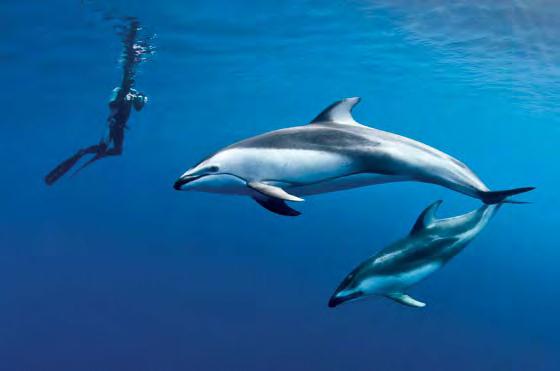
Pacific white-sided dolphins swim 12 miles off the San Diego, Calif., coast.
This is a SEO version of AlertDiver_Summer2011_web. Click here to view full version
« Previous Page Table of Contents Next Page »