This is a SEO version of AlertDiver_Summer2011_web. Click here to view full version
« Previous Page Table of Contents Next Page »V
olcanoes traditionally conjure visions of Mount St. Helens-like behemoths erupting with lava flowing ominously down a mountainside. But not all volcanoes are on land nor are they always destructive. Hydrothermal vents are underwater volcanoes that play an important role in the ocean’s temperature, chemistry and circulation patterns, and they contain extremely valuable resources sought by scientists, governments and private industry, creating debate about whether the riches are worth great risk.
LIFE AT 7,000 FEET
Although hydrothermal vents likely began forming millions of years ago, scientists became aware of them only 34 years ago. Found on seabeds at depths of 7,000 feet, hydrothermal vents are often nestled among vast underwater mountain ranges. They form when the earth’s tectonic plates shift, creating cracks in the ocean floor and allowing geysers of rich mineral water to escape.
Although most of the deep ocean where hydrothermal vents are found is sparsely populated, they are teeming with minerals and organisms. Since their discovery, more than 1,300 previously unknown species have been identified at vent sites, and even more new creatures are found with each visit. The food web in the ecosystems of hydrothermal vents is 300 to 500 times more concentrated than that of the surrounding waters. It is based not on photosynthesis (which requires light) but on bacteria that use the energy found in hydrogen sulfide, a chemical poisonous to most animals. Because the water from the hydrothermal vents is so rich in hydrogen sulfide, the bacteria are able to form dense masses in and around the hot water vents. Despite their microscopic size, the bacteria are the primary producers in the food web and support a wide variety of other marine life including tubeworms, giant clams, shrimp, mussels and lobsters.
WHAT LIES BENEATH
While the marine life of a hydrothermal vent is enough to keep anyone riveted, what really catches the attention of many on the surface are the potential riches to be found. Pound for pound, seafoor ore has more gold, zinc and silver than land deposits do. In 2009 Nautilus Minerals, a Canada-based seafoor-mining company, estimated there are thousands of vent systems under the sea, creating the potential for an annual yield of “several billion tons of copper” alone. Copper is a key component in construction, power generation and transmission, industrial machinery, transportation, heating and cooling systems, electronics, plumbing and telecommunications. Other minerals found in hydrothermal vents include nickel, cobalt and rarer minerals such as tellurium, which is used in the manufacturing of computers, CDs, DVDs and batteries.
But the value of hydrothermal vents extends beyond the minerals. Scientists have also discovered in hydrothermal vents microbes found nowhere else on earth that may hold the key to the development of new drugs, industrial processes and other products. Scientists believe the microbes are as economically valuable as the vents’ minerals because they are sources of enzymes used in DNA fngerprinting, detergents and the enhancement of oil fow from old wells. Te microbes also produce bioactive compounds that may have pharmaceutical applications in cures for cancer and other diseases. Even more fascinating, hydrothermal vents demonstrate accelerated biological and geological processes that far
WATER PLANET
96 | SUMMER 2011
Hydrothermal Vents
Mysterious empires of the deep ocean
B y H i l l a r y V i d e r s , P h . D .
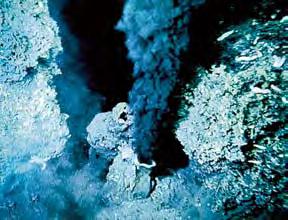
Clockwise from below: a black smoker hydrothermal vent in the East Pacific Rise; zoarcid fish and mussels at a vent site; the Alvin submersible vehicle on board the R/V Atlantis in preparation for a hydrothermal vent exploration in 2000
This is a SEO version of AlertDiver_Summer2011_web. Click here to view full version
« Previous Page Table of Contents Next Page »